Abstract
Artificial intelligence (AI) has been widely adopted in social science research, as exemplified by AI-based social event analysis to understand how these events are spreading across social media. However, there is a lack of a comprehensive analytical methodology exploring symbiotic relationships between AI and complex social events. We find that social events usually exist spanning from the occurring physical domain, media information domain, and human cognition domain. To comprehensively understand these events across these three domains, we propose a solution called Social Event Intelligence (SEI), where large AI models (e.g., large language models) and small models (e.g., classical deep learning models) are dynamically integrated to achieve flexible and accurate social event analysis. SEI is grounded for AI-driven social science where physical, information, and cognition knowledge are harmoniously converged. Delineation of SEI's theoretical underpinnings in the social event lifecycle is designed. SEI analytical workflows are illustrated through two case studies, i.e., the French protests event and the superconductors discourse incident. This research builds foundations for systematic social event analysis, which can elucidate how AI can help to understand societal events easily, efficiently, and systematically.
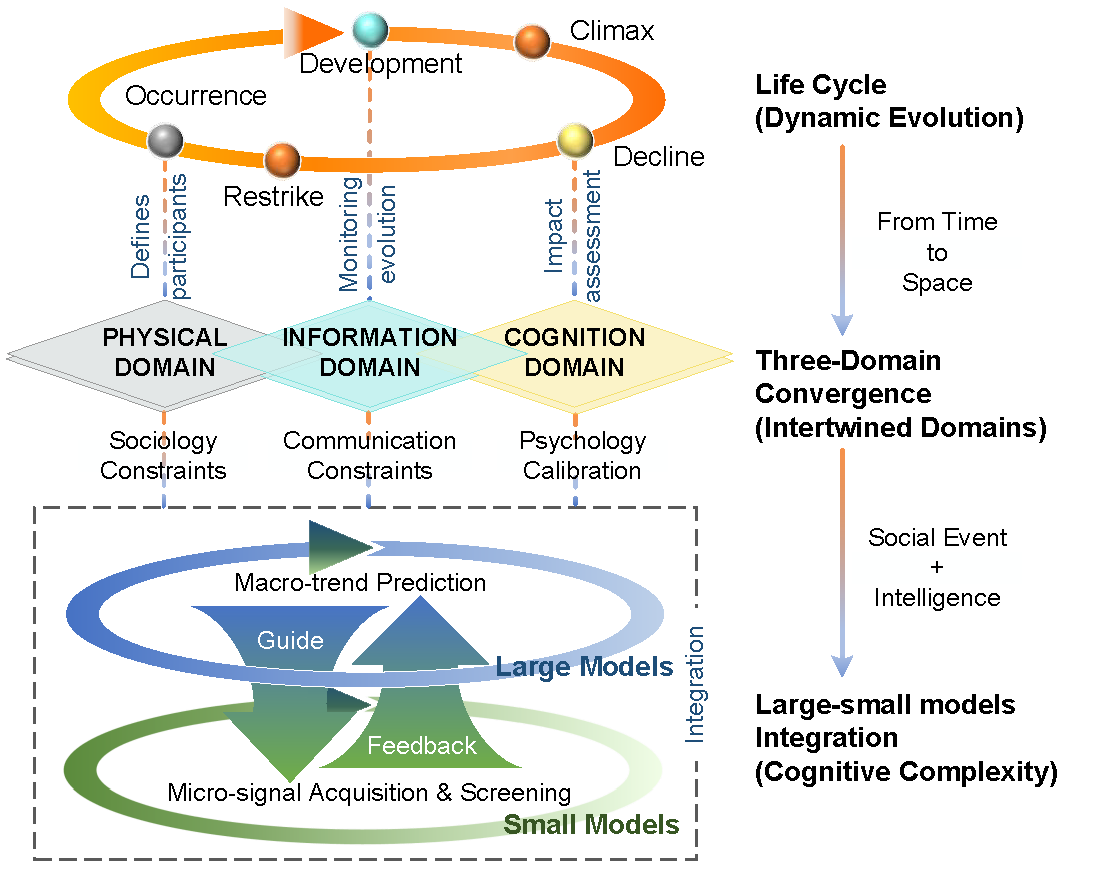
Fig 1. The Overall Architecture of Social Event Intelligence (SEI), illustrating the synergy between the Event Lifecycle, Three-Domain Convergence, and Large-Small Model Integration.